
Duncan Harrison // fires.serif. TAPE
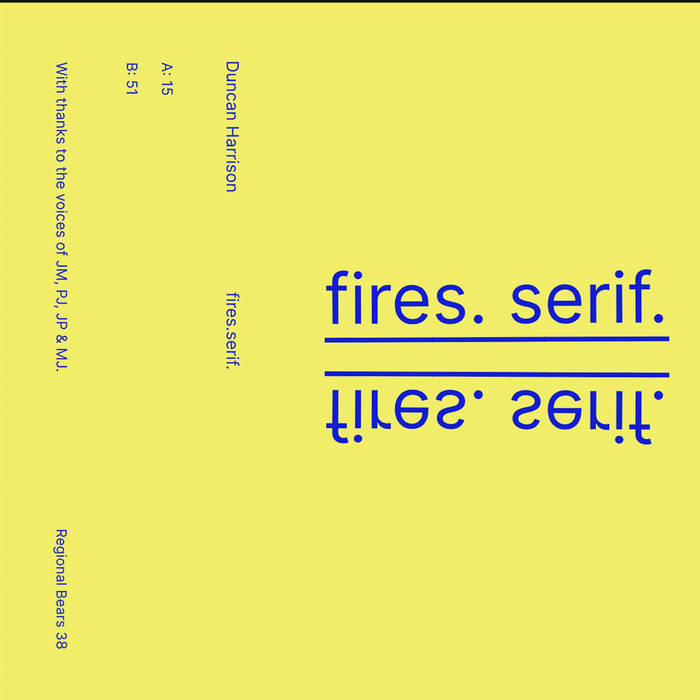


Duncan Harrison // fires.serif. TAPE
¥1,980
- Item no:
- Availability:
イギリス・ストックポートの実験レーベルRegional Bears諸作を入荷しました。
本作は、同国ブライトンの物音作家Duncan Harrisonが、2021年にリリースしたカセットです。
物音コラージュスケープ2曲、32分を収録。廃盤です。
レーベルその他作品はこちら /// Click here to see more Regional Bears releases available at Tobira.
artist : Duncan Harrison
label : Regional Bears
Related Products

クイックビュー
{"id":9459951272186,"title":"John Also Bennett \/\/ Sacred House (Versions) TAPE","handle":"john-also-bennett-sacred-house-versions-tape","description":"\u003cp\u003eアメリカ出身ギリシャ在住のフルート奏者John Also Bennettが、\u003cspan\u003e2026年6月にフランスの実験レーベルShelter Pressからリリースしたカセットです。\u003c\/span\u003e\u003c\/p\u003e\n\u003cp\u003e同じ楽曲を異なる3種の楽器ピアノ、フルート、シンセで演奏した4曲を収録。B面はリピートです。\u003c\/p\u003e\n\u003cp\u003eマスタリングはRashad Beckerが担当しています。\u003c\/p\u003e\n\u003cp\u003e\u003ca href=\"https:\/\/tobirarecords.com\/products\/john-also-bennett-elaiona-lp-color\"\u003e前作\u003c\/a\u003eもオススメです。\u003c\/p\u003e\n\u003cp\u003e※デジタル音源を無料でお送りいたしますのでお気軽にご連絡くださいませ\u003c\/p\u003e\n\u003cp\u003e以下、レーベルによる解説です。\u003c\/p\u003e\n\u003cdiv style=\"color: inherit;\"\u003e\n\u003cp\u003e\u003cem\u003e\"『Sacred House (Versions)』は、アメリカの作曲家John Also Bennettによる26分間のEPだ。2025年のアルバム『Ston Elaióna』で初公開された、ミニマルで心に響く楽曲「Sacred House」の4つのバリエーションで構成される『Sacred House (Versions)』は、共鳴、空虚な空間、そしてそのすぐ下に隠された細部へのJohn Also Bennettの探求を継続している。ピアノ、バスフルート、シンセサイザーを用いて、同じ楽曲でありながら驚くほど異なる、しかし完全に一貫性のある新しいバージョンを生み出している。\u003c\/em\u003e\u003c\/p\u003e\n\u003cp\u003e\u003cem\u003eEPは「Sacred House (Piano)」で幕を開ける。これは、John Also Bennettの故人となった共同制作者マイケル・ハリソンによって、純正律のラーガ音階に調律されたスタインウェイで録音されたものだ。作品を物理的な領域に位置づけるため、ピアノには近接マイクが設置され、その微細できらめく共鳴パターンが高精細に捉えられている。スタジオの外から聞こえてくる晩夏の音風景がかすかに感じられ、聴き手をピアノのある部屋に直接誘い込む――John Also Bennettの忍耐強い和音の進行が展開されるにつれ、空気そのものが聴こえてくるようだ。\u003c\/em\u003e\u003c\/p\u003e\n\u003cp\u003e\u003cem\u003e「Sacred House (Bass Flute)」では、John Also Bennettのバスフルートが使用されており、ここでは同じ音を3回マルチトラック録音している。木管楽器用にアレンジされたこの曲は、ほとんど王侯貴族のような雰囲気を帯びており、その長音はフィル・ニブロックの「Four Full Flutes」を彷彿とさせるビート音錯覚を引き出しているが、より息づく余地がある。「Sacred House (Prophet)」ではプロフェット・シンセサイザーが使用され、EPを超現実的な空間へと導く。長い音色が燃えるような地平線を滑るように渡り、空へと溶け込んでいく。これは、EPの最後を飾るDX7用オリジナル・バージョンの、繊細な水滴のような音色とは対照的だ。\u003c\/em\u003e\u003c\/p\u003e\n\u003cp\u003e\u003cem\u003eJohn Also Bennettの音楽の多くと同様に、集中して聴くことで、これまで気づかなかった音の次元が明らかになり、鮮やかな潜在意識のイメージが呼び起こされる。「Sacred House」というタイトルは、John Also Bennettが居住するギリシャの古代ドドニにあった、神託所を収めた建物に由来する。ドドニ神殿の特筆すべき点は、中庭に立つ神聖な樫の木だった。祭司や巫女たちは、葉を揺らす風のさざめきや青銅の大釜から響く音に耳を傾け、それらの音を神の知恵として解釈していた。John Also Bennettが単純な音の細部に深く関わり、思慮深く考察する姿勢は、おそらくその慣習を反映しているのだろう――音の神秘に細やかに耳を澄ませることで、洞察を得ようとする謙虚な願いである。\"\u003c\/em\u003e\u003c\/p\u003e\n\u003c\/div\u003e\n\u003cp\u003e\u003ciframe style=\"border: 0; width: 100%; height: 120px;\" src=\"https:\/\/bandcamp.com\/EmbeddedPlayer\/album=1944304053\/size=large\/bgcol=ffffff\/linkcol=0687f5\/tracklist=false\/artwork=none\/transparent=true\/\"\u003e\u003c\/iframe\u003e\u003c\/p\u003e\n\u003cp\u003e\u003ciframe style=\"border: 0; width: 100%; height: 120px;\" src=\"https:\/\/bandcamp.com\/EmbeddedPlayer\/album=1944304053\/size=large\/bgcol=ffffff\/linkcol=0687f5\/tracklist=false\/artwork=none\/track=194120321\/transparent=true\/\"\u003e\u003c\/iframe\u003e\u003c\/p\u003e\n\u003cp\u003eレーベルその他作品は\u003ca href=\"https:\/\/tobirarecords.com\/collections\/shelter\"\u003eこちら\u003c\/a\u003e\u003cspan\u003e \u003c\/span\u003e\/\/\/ Click \u003ca href=\"https:\/\/tobirarecords.com\/collections\/shelter\"\u003ehere\u003c\/a\u003e to see more Shelter Press \/ \u003cmeta charset=\"utf-8\"\u003e\u003cspan\u003eRecollection GRM\u003c\/span\u003e \/ Ideologic Organ releases available at Tobira. \u003c\/p\u003e\n\u003cp\u003e------------------------------\u003c\/p\u003e\n\u003cp\u003eCassette in norelco case.\u003cbr\u003eEdition of 100 copies.\u003cbr\u003eAsk us for digital files.\u003c\/p\u003e\n\u003cp\u003e\u003cstrong\u003eTracklist\u003c\/strong\u003e:\u003c\/p\u003e\n\u003cp\u003e1. Sacred House (Piano) 05:26 \u003cbr\u003e2. Sacred House (Bass Flute) 04:53 \u003cbr\u003e3. Sacred House (Prophet) 10:28 \u003cbr\u003e4. Sacred House 05:08\u003c\/p\u003e\n\u003cp\u003e \u003c\/p\u003e\n\u003cp\u003eFrom the label:\u003c\/p\u003e\n\u003cp\u003e\"\u003cmeta charset=\"utf-8\"\u003e\u003cem\u003eSacred House (Versions) is a 26 minute EP by American composer John Also Bennett. Consisting of four variations on “Sacred House”, a minimal, haunting composition first released on his 2025 album Ston Elaióna, Sacred House (Versions) continues Bennett’s engagement with resonance, empty space, and the small details hidden just below, using piano, bass flute, and synthesizers to create remarkably different yet entirely coherent new versions of the same piece of music.\u003c\/em\u003e\u003cbr\u003e\u003cbr\u003e\u003cem\u003eThe EP opens with “Sacred House (Piano)”, recorded on a Steinway tuned in a just-intonation raga scale by Bennett’s late collaborator Michael Harrison. Positioning the work in the physical realm, the piano was close-miked to capture its microscopic, shimmering resonance patterns in high definition. The late summer soundscape from outside of the studio is just perceptable, placing the listener directly in the room with the piano - the air becomes audible as Bennett’s patient chord progressions unfold.\u003c\/em\u003e\u003cbr\u003e\u003cbr\u003e\u003cem\u003e“Sacred House (Bass Flute)” uses Bennett’s bass flute, here multi-tracked on top of itself three times. Arranged for woodwinds the piece takes on an almost regal air, its held notes bringing out beating tone illusions reminiscent of Phill Niblock’s “Four Full\u003cspan class=\"bcTruncateMore\"\u003e Flutes”, but with more room to breathe. “Sacred House (Prophet)” uses a Prophet synthesizer, bringing the EP into a hyper-real space. Long tones glide across a burning horizon and melt into the sky, in contrast to the delicate water beads of the original version for DX7, which closes out the EP.\u003cbr\u003e\u003cbr\u003eAs with much of Bennett’s music, focused listening can reveal previously unheard dimensions of sound and trigger vivid, subconscious imagery. The title “Sacred House” stems from the building that housed the oracle of ancient Dodoni in Greece, the country in which Bennett resides. Unique to the Dodoni temple was the sacred oak tree in its courtyard; priests and priestesses would listen to the wind rustling through its leaves, and to ringing tones from bronze cauldrons, interpreting these sounds as divine wisdom. Bennett’s engagement with and thoughtful consideration of simple sonic details perhaps mirrors that practice - a humble desire to attain insight by tuning in closely to the mysteries of sound.\"\u003c\/span\u003e\u003c\/em\u003e\u003c\/p\u003e\n\u003cp\u003eArtist : John Also Bennett\u003c\/p\u003e\n\u003cp\u003eLabel : Shelter Press\u003c\/p\u003e\n\u003cp\u003ecat no : \u003cmeta charset=\"utf-8\"\u003e\u003cspan\u003eSP166\u003c\/span\u003e\u003c\/p\u003e\n\u003cp\u003e\u003cspan\u003eRelease date : July 2026\u003c\/span\u003e\u003c\/p\u003e","published_at":"2026-09-20T13:57:47+09:00","created_at":"2026-09-20T09:01:54+09:00","vendor":"Tobira Records","type":"","tags":["ambient","contemporary \/ sound poetry","drone","jazz","new","recommended","shelter press","tape"],"price":263000,"price_min":263000,"price_max":263000,"available":true,"price_varies":false,"compare_at_price":null,"compare_at_price_min":0,"compare_at_price_max":0,"compare_at_price_varies":false,"variants":[{"id":50468817567994,"title":"Default Title","option1":"Default Title","option2":null,"option3":null,"sku":null,"requires_shipping":true,"taxable":true,"featured_image":null,"available":true,"name":"John Also Bennett \/\/ Sacred House (Versions) TAPE","public_title":null,"options":["Default Title"],"price":263000,"weight":60,"compare_at_price":null,"inventory_management":"shopify","barcode":null,"requires_selling_plan":false,"selling_plan_allocations":[],"quantity_rule":{"min":1,"max":null,"increment":1}}],"images":["\/\/tobirarecords.com\/cdn\/shop\/files\/john1_ae88969a-2421-412b-a424-db1b1a525676.jpg?v=1789862435","\/\/tobirarecords.com\/cdn\/shop\/files\/john2_445e8132-4384-40ff-91bf-48b8b46a5854.jpg?v=1789862435"],"featured_image":"\/\/tobirarecords.com\/cdn\/shop\/files\/john1_ae88969a-2421-412b-a424-db1b1a525676.jpg?v=1789862435","options":["Title"],"media":[{"alt":null,"id":41220204888314,"position":1,"preview_image":{"aspect_ratio":1.0,"height":350,"width":350,"src":"\/\/tobirarecords.com\/cdn\/shop\/files\/john1_ae88969a-2421-412b-a424-db1b1a525676.jpg?v=1789862435"},"aspect_ratio":1.0,"height":350,"media_type":"image","src":"\/\/tobirarecords.com\/cdn\/shop\/files\/john1_ae88969a-2421-412b-a424-db1b1a525676.jpg?v=1789862435","width":350},{"alt":null,"id":41220204921082,"position":2,"preview_image":{"aspect_ratio":1.333,"height":900,"width":1200,"src":"\/\/tobirarecords.com\/cdn\/shop\/files\/john2_445e8132-4384-40ff-91bf-48b8b46a5854.jpg?v=1789862435"},"aspect_ratio":1.333,"height":900,"media_type":"image","src":"\/\/tobirarecords.com\/cdn\/shop\/files\/john2_445e8132-4384-40ff-91bf-48b8b46a5854.jpg?v=1789862435","width":1200}],"requires_selling_plan":false,"selling_plan_groups":[],"content":"\u003cp\u003eアメリカ出身ギリシャ在住のフルート奏者John Also Bennettが、\u003cspan\u003e2026年6月にフランスの実験レーベルShelter Pressからリリースしたカセットです。\u003c\/span\u003e\u003c\/p\u003e\n\u003cp\u003e同じ楽曲を異なる3種の楽器ピアノ、フルート、シンセで演奏した4曲を収録。B面はリピートです。\u003c\/p\u003e\n\u003cp\u003eマスタリングはRashad Beckerが担当しています。\u003c\/p\u003e\n\u003cp\u003e\u003ca href=\"https:\/\/tobirarecords.com\/products\/john-also-bennett-elaiona-lp-color\"\u003e前作\u003c\/a\u003eもオススメです。\u003c\/p\u003e\n\u003cp\u003e※デジタル音源を無料でお送りいたしますのでお気軽にご連絡くださいませ\u003c\/p\u003e\n\u003cp\u003e以下、レーベルによる解説です。\u003c\/p\u003e\n\u003cdiv style=\"color: inherit;\"\u003e\n\u003cp\u003e\u003cem\u003e\"『Sacred House (Versions)』は、アメリカの作曲家John Also Bennettによる26分間のEPだ。2025年のアルバム『Ston Elaióna』で初公開された、ミニマルで心に響く楽曲「Sacred House」の4つのバリエーションで構成される『Sacred House (Versions)』は、共鳴、空虚な空間、そしてそのすぐ下に隠された細部へのJohn Also Bennettの探求を継続している。ピアノ、バスフルート、シンセサイザーを用いて、同じ楽曲でありながら驚くほど異なる、しかし完全に一貫性のある新しいバージョンを生み出している。\u003c\/em\u003e\u003c\/p\u003e\n\u003cp\u003e\u003cem\u003eEPは「Sacred House (Piano)」で幕を開ける。これは、John Also Bennettの故人となった共同制作者マイケル・ハリソンによって、純正律のラーガ音階に調律されたスタインウェイで録音されたものだ。作品を物理的な領域に位置づけるため、ピアノには近接マイクが設置され、その微細できらめく共鳴パターンが高精細に捉えられている。スタジオの外から聞こえてくる晩夏の音風景がかすかに感じられ、聴き手をピアノのある部屋に直接誘い込む――John Also Bennettの忍耐強い和音の進行が展開されるにつれ、空気そのものが聴こえてくるようだ。\u003c\/em\u003e\u003c\/p\u003e\n\u003cp\u003e\u003cem\u003e「Sacred House (Bass Flute)」では、John Also Bennettのバスフルートが使用されており、ここでは同じ音を3回マルチトラック録音している。木管楽器用にアレンジされたこの曲は、ほとんど王侯貴族のような雰囲気を帯びており、その長音はフィル・ニブロックの「Four Full Flutes」を彷彿とさせるビート音錯覚を引き出しているが、より息づく余地がある。「Sacred House (Prophet)」ではプロフェット・シンセサイザーが使用され、EPを超現実的な空間へと導く。長い音色が燃えるような地平線を滑るように渡り、空へと溶け込んでいく。これは、EPの最後を飾るDX7用オリジナル・バージョンの、繊細な水滴のような音色とは対照的だ。\u003c\/em\u003e\u003c\/p\u003e\n\u003cp\u003e\u003cem\u003eJohn Also Bennettの音楽の多くと同様に、集中して聴くことで、これまで気づかなかった音の次元が明らかになり、鮮やかな潜在意識のイメージが呼び起こされる。「Sacred House」というタイトルは、John Also Bennettが居住するギリシャの古代ドドニにあった、神託所を収めた建物に由来する。ドドニ神殿の特筆すべき点は、中庭に立つ神聖な樫の木だった。祭司や巫女たちは、葉を揺らす風のさざめきや青銅の大釜から響く音に耳を傾け、それらの音を神の知恵として解釈していた。John Also Bennettが単純な音の細部に深く関わり、思慮深く考察する姿勢は、おそらくその慣習を反映しているのだろう――音の神秘に細やかに耳を澄ませることで、洞察を得ようとする謙虚な願いである。\"\u003c\/em\u003e\u003c\/p\u003e\n\u003c\/div\u003e\n\u003cp\u003e\u003ciframe style=\"border: 0; width: 100%; height: 120px;\" src=\"https:\/\/bandcamp.com\/EmbeddedPlayer\/album=1944304053\/size=large\/bgcol=ffffff\/linkcol=0687f5\/tracklist=false\/artwork=none\/transparent=true\/\"\u003e\u003c\/iframe\u003e\u003c\/p\u003e\n\u003cp\u003e\u003ciframe style=\"border: 0; width: 100%; height: 120px;\" src=\"https:\/\/bandcamp.com\/EmbeddedPlayer\/album=1944304053\/size=large\/bgcol=ffffff\/linkcol=0687f5\/tracklist=false\/artwork=none\/track=194120321\/transparent=true\/\"\u003e\u003c\/iframe\u003e\u003c\/p\u003e\n\u003cp\u003eレーベルその他作品は\u003ca href=\"https:\/\/tobirarecords.com\/collections\/shelter\"\u003eこちら\u003c\/a\u003e\u003cspan\u003e \u003c\/span\u003e\/\/\/ Click \u003ca href=\"https:\/\/tobirarecords.com\/collections\/shelter\"\u003ehere\u003c\/a\u003e to see more Shelter Press \/ \u003cmeta charset=\"utf-8\"\u003e\u003cspan\u003eRecollection GRM\u003c\/span\u003e \/ Ideologic Organ releases available at Tobira. \u003c\/p\u003e\n\u003cp\u003e------------------------------\u003c\/p\u003e\n\u003cp\u003eCassette in norelco case.\u003cbr\u003eEdition of 100 copies.\u003cbr\u003eAsk us for digital files.\u003c\/p\u003e\n\u003cp\u003e\u003cstrong\u003eTracklist\u003c\/strong\u003e:\u003c\/p\u003e\n\u003cp\u003e1. Sacred House (Piano) 05:26 \u003cbr\u003e2. Sacred House (Bass Flute) 04:53 \u003cbr\u003e3. Sacred House (Prophet) 10:28 \u003cbr\u003e4. Sacred House 05:08\u003c\/p\u003e\n\u003cp\u003e \u003c\/p\u003e\n\u003cp\u003eFrom the label:\u003c\/p\u003e\n\u003cp\u003e\"\u003cmeta charset=\"utf-8\"\u003e\u003cem\u003eSacred House (Versions) is a 26 minute EP by American composer John Also Bennett. Consisting of four variations on “Sacred House”, a minimal, haunting composition first released on his 2025 album Ston Elaióna, Sacred House (Versions) continues Bennett’s engagement with resonance, empty space, and the small details hidden just below, using piano, bass flute, and synthesizers to create remarkably different yet entirely coherent new versions of the same piece of music.\u003c\/em\u003e\u003cbr\u003e\u003cbr\u003e\u003cem\u003eThe EP opens with “Sacred House (Piano)”, recorded on a Steinway tuned in a just-intonation raga scale by Bennett’s late collaborator Michael Harrison. Positioning the work in the physical realm, the piano was close-miked to capture its microscopic, shimmering resonance patterns in high definition. The late summer soundscape from outside of the studio is just perceptable, placing the listener directly in the room with the piano - the air becomes audible as Bennett’s patient chord progressions unfold.\u003c\/em\u003e\u003cbr\u003e\u003cbr\u003e\u003cem\u003e“Sacred House (Bass Flute)” uses Bennett’s bass flute, here multi-tracked on top of itself three times. Arranged for woodwinds the piece takes on an almost regal air, its held notes bringing out beating tone illusions reminiscent of Phill Niblock’s “Four Full\u003cspan class=\"bcTruncateMore\"\u003e Flutes”, but with more room to breathe. “Sacred House (Prophet)” uses a Prophet synthesizer, bringing the EP into a hyper-real space. Long tones glide across a burning horizon and melt into the sky, in contrast to the delicate water beads of the original version for DX7, which closes out the EP.\u003cbr\u003e\u003cbr\u003eAs with much of Bennett’s music, focused listening can reveal previously unheard dimensions of sound and trigger vivid, subconscious imagery. The title “Sacred House” stems from the building that housed the oracle of ancient Dodoni in Greece, the country in which Bennett resides. Unique to the Dodoni temple was the sacred oak tree in its courtyard; priests and priestesses would listen to the wind rustling through its leaves, and to ringing tones from bronze cauldrons, interpreting these sounds as divine wisdom. Bennett’s engagement with and thoughtful consideration of simple sonic details perhaps mirrors that practice - a humble desire to attain insight by tuning in closely to the mysteries of sound.\"\u003c\/span\u003e\u003c\/em\u003e\u003c\/p\u003e\n\u003cp\u003eArtist : John Also Bennett\u003c\/p\u003e\n\u003cp\u003eLabel : Shelter Press\u003c\/p\u003e\n\u003cp\u003ecat no : \u003cmeta charset=\"utf-8\"\u003e\u003cspan\u003eSP166\u003c\/span\u003e\u003c\/p\u003e\n\u003cp\u003e\u003cspan\u003eRelease date : July 2026\u003c\/span\u003e\u003c\/p\u003e"}
You may also like:
アメリカ出身ギリシャ在住のフルート奏者John Also Bennettが、2026年6月にフランスの実験レーベルShelter Pressからリリースしたカセットです。 同じ楽曲を異なる3種の楽器ピアノ、フルート、シンセで演奏した4曲を収録。B面はリピートです。 マスタリングはRashad Beckerが担当しています。 前作もオススメです。 ※デジタル音源を無料でお送りいたしますのでお気軽にご連絡くださいませ 以下、レーベルによる解説です。 "『Sacred House (Versions)』は、アメリカの作曲家John Also...
¥2,630

クイックビュー
{"id":9418991599866,"title":"Bridget Ferrill \u0026 Áslaug Magnúsdóttir \/\/ itself between, of saying farewell CD","handle":"bridget-ferrill-aslaug-magnusdottir-itself-between-of-saying-farewell-cd","description":"\u003cp\u003e実験音楽家Bridget Ferrill \u0026amp; Áslaug Magnúsdóttirが、2026年7月にウェールズの実験レーベルDiscreet Archiveから50部限定でリリースしたCDです。\u003c\/p\u003e\n\u003cp\u003e実験オペラ〜物音〜ドローン9曲を収録。デジパック、シュリンク仕様です。28ページの台本が付属。\u003c\/p\u003e\n\u003cp\u003e以下、レーベルによる解説です。\u003c\/p\u003e\n\u003cp\u003e\"\u003ci\u003e『itself between, of saying farewell』は、Bridget FerrillとÁslaug Magnúsdóttir、\u003cem\u003eOlivia Rivière\u003c\/em\u003eによる2幕構成のオペラだ。ハープ、エレクトリック・ハープ、クラリネット、声、マイク、クラヴィコード、電子音を用いて書かれたこの作品は、愛着、痛み、そして解放をめぐる奇妙で親密な寓話を紡ぎ出す。\u003c\/i\u003e\u003c\/p\u003e\n\u003cp\u003e\u003cem\u003e台本の中心には、「靴」「足」「釘」という3つの存在がいる。「靴」は「足」に恋をしている。「足」は「至福の家」を探すために旅立つ。「靴」は「釘」を説得し、自分と「足」の両方を貫くよう促す。そうすることで、二人は結びつけられるのだ。足は、足取りが不安定であれ、痛みがあろうとも、旅を続ける。彼らの周囲には、「血」「塵」「白鳥」という3つの合唱団が集まる。これらの声は、身体感覚、道、天候、記憶、そして内省の間を行き来し、作品に変化に富んだ風景を与えている。\u003c\/em\u003e\u003c\/p\u003e\n\u003cp\u003e\u003cem\u003eこのオペラは、恐怖がどのように身体に根ざすか、献身がいかにして構造へと硬化するか、そして思いやりがいかにして束縛となり得るかを探求している。台本の言葉は率直で、不安定かつイメージに富み、夢の論理、家庭内の細部、感情分析、そして演劇的な語り口の間を行き来する。靴は家となり、傷となり、伝統となり、結びつく手段となる。釘は固定具であると同時に、恐怖の場ともなる。至福の家へ向かうフットの旅路は、そこに固定されたものの重みによって形作られる。\u003c\/em\u003e\u003c\/p\u003e\n\u003cp\u003e\u003cem\u003eFerrillとMagnúsdóttirの音響世界は、撥弦、鍵盤、吹奏、そして加工された音の儚いメカニズムを通じて、このドラマを拡張する。ハープ、クラリネット、クラヴィコードは古い楽器形態を連想させるが、ここではそれらが透過的で、部分的であり、物理的に身近なものとなっている。エレクトロニクスはこれらの素材のスケールを変え、摩擦、共鳴、不安定さを引き出す。\u003ci\u003eRivière\u003c\/i\u003eの声とマイクを用いた表現は、このオペラにさらなる身体的な次元を与え、声の響きをテクスチャー、発話、息、圧力として扱う。\u003c\/em\u003e\u003c\/p\u003e\n\u003cp\u003e\u003ci\u003eこの作品は、室内オペラと親密な演劇の間を行き来する。その感情の動きは、微細な音色の変化、繰り返されるイメージ、そして静寂の圧力によって伝えられる。このオペラは、絆がいかにして安らぎであると同時に傷とも感じられるのか、人が「抱きしめること」を「気遣い」と誤解してしまうのはなぜか、そして「去ること」がいかにして必要な形の「気遣い」となり得るのかを問うものだ。\u003c\/i\u003e\u003cem\u003e\"\u003c\/em\u003e\u003c\/p\u003e\n\u003cp\u003e\u003ciframe style=\"border: 0; width: 100%; height: 120px;\" src=\"https:\/\/bandcamp.com\/EmbeddedPlayer\/album=387645504\/size=large\/bgcol=ffffff\/linkcol=0687f5\/tracklist=false\/artwork=none\/transparent=true\/\"\u003e\u003c\/iframe\u003e\u003c\/p\u003e\n\u003cp\u003eレーベルその他作品は\u003ca href=\"https:\/\/tobirarecords.com\/collections\/diar\"\u003eこちら\u003c\/a\u003e \/\/\/ Click \u003ca href=\"https:\/\/tobirarecords.com\/collections\/diar\"\u003ehere\u003c\/a\u003e to see more Discreet Archive releases available at Tobira.\u003c\/p\u003e\n\u003cp\u003e------------------------------------\u003c\/p\u003e\n\u003cp\u003eCD in digipack.\u003cbr\u003eIncludes 28-page libretto. \u003cbr\u003eEdition of 50 copies.\u003c\/p\u003e\n\u003cp\u003e\u003cstrong\u003eTracklist\u003c\/strong\u003e:\u003c\/p\u003e\n\u003cp\u003e1. Prelude 01:39 \u003cbr\u003e2. Aria 05:06 \u003cbr\u003e3. Mad Scene 06:33 \u003cbr\u003e4. Leitmotif By The Lake 05:21 \u003cbr\u003e5. Disintegration Ossia 02:38 \u003cbr\u003e6. Insertion Fioritura 02:34 \u003cbr\u003e7. Finale Concertato 03:29 \u003cbr\u003e8. Zwischenspiel 02:19 \u003cbr\u003e9. Finale 02:08\u003c\/p\u003e\n\u003cp\u003e \u003c\/p\u003e\n\u003cp\u003eFrom the label:\u003c\/p\u003e\n\u003cp\u003e\"\u003cmeta charset=\"utf-8\"\u003e\u003cem\u003eitself between, of saying farewell is an opera in two parts by Bridget Ferrill, Áslaug Magnúsdóttir and Olivia Rivière. Written through harp, electric harp, clarinet, voice, microphone, clavichord and electronics, the work moves through a strange and intimate parable of attachment, pain and release.\u003c\/em\u003e\u003cbr\u003e\u003cbr\u003e\u003cem\u003eAt the centre of the libretto are three figures: Shoe, Foot and Nail. Shoe is in love with Foot. Foot is leaving to find the House of Bliss. Shoe convinces Nail to impale itself through both Shoe and Foot so that they are held together. Foot continues the journey, despite the uneven step, despite the pain. Around them gather three choruses: Blood, Dust and Swan. These voices give the work its shifting terrain, moving between bodily sensation, path, weather, memory and reflection.\u003c\/em\u003e\u003cbr\u003e\u003cbr\u003e\u003cem\u003eThe opera explores how fear locates itself in the body, how devotion can harden into structure, and how care can become constraint. The language of the libretto is direct, unstable and image-rich, moving between dream logic, domestic detail, emotional analysis and theatrical address. A shoe becomes a house, a wound, a tradition, a method of attachment. A nail becomes both a fastening and a site of fear. Foot’s journey toward the House of Bliss is shaped by\u003cspan class=\"bcTruncateMore\"\u003e the weight of what has been fixed to it.\u003cbr\u003e\u003cbr\u003eFerrill and Magnúsdóttir’s sound world extends this drama through the fragile mechanics of plucked, keyed, blown and processed sound. Harp, clarinet and clavichord carry associations of older instrumental forms, but here they are made porous, partial and physically close. Electronics shift the scale of these materials, drawing out friction, resonance and instability. Rivière’s voice and microphone practice gives the opera a further bodily dimension, treating vocal sound as texture, utterance, breath and pressure.\u003cbr\u003e\u003cbr\u003eThe work moves between chamber opera and intimate theatre. Its emotional movement is carried through small changes of tone, repeated images and the pressure of quiet. The opera asks how a bond can be felt as shelter and injury at the same time, how a person might mistake holding for care, and how leaving can become a necessary form of attention.\"\u003c\/span\u003e\u003c\/em\u003e\u003c\/p\u003e\n\u003cp\u003eArtist : Bridget Ferrill \u0026amp; Áslaug Magnúsdóttir\u003c\/p\u003e\n\u003cp\u003eLabel : Discreet Archive\u003c\/p\u003e\n\u003cp\u003eRelease date : 24th July 2026\u003c\/p\u003e","published_at":"2026-09-10T15:58:24+09:00","created_at":"2026-09-10T13:12:57+09:00","vendor":"Tobira Records","type":"","tags":["cd","contemporary \/ sound poetry","discreet archive","drone","monooto","new"],"price":291600,"price_min":291600,"price_max":291600,"available":true,"price_varies":false,"compare_at_price":null,"compare_at_price_min":0,"compare_at_price_max":0,"compare_at_price_varies":false,"variants":[{"id":50271215845626,"title":"Default Title","option1":"Default Title","option2":null,"option3":null,"sku":null,"requires_shipping":true,"taxable":true,"featured_image":null,"available":true,"name":"Bridget Ferrill \u0026 Áslaug Magnúsdóttir \/\/ itself between, of saying farewell CD","public_title":null,"options":["Default Title"],"price":291600,"weight":90,"compare_at_price":null,"inventory_management":"shopify","barcode":null,"requires_selling_plan":false,"selling_plan_allocations":[],"quantity_rule":{"min":1,"max":null,"increment":1}}],"images":["\/\/tobirarecords.com\/cdn\/shop\/files\/be1_abeb930f-895f-4aee-9709-e6a93c48ff51.jpg?v=1789013491","\/\/tobirarecords.com\/cdn\/shop\/files\/be2_7714ca72-a128-4fb0-b367-e1255110ac10.jpg?v=1789013491"],"featured_image":"\/\/tobirarecords.com\/cdn\/shop\/files\/be1_abeb930f-895f-4aee-9709-e6a93c48ff51.jpg?v=1789013491","options":["Title"],"media":[{"alt":null,"id":40993871233274,"position":1,"preview_image":{"aspect_ratio":1.0,"height":350,"width":350,"src":"\/\/tobirarecords.com\/cdn\/shop\/files\/be1_abeb930f-895f-4aee-9709-e6a93c48ff51.jpg?v=1789013491"},"aspect_ratio":1.0,"height":350,"media_type":"image","src":"\/\/tobirarecords.com\/cdn\/shop\/files\/be1_abeb930f-895f-4aee-9709-e6a93c48ff51.jpg?v=1789013491","width":350},{"alt":null,"id":40993871266042,"position":2,"preview_image":{"aspect_ratio":0.75,"height":1200,"width":900,"src":"\/\/tobirarecords.com\/cdn\/shop\/files\/be2_7714ca72-a128-4fb0-b367-e1255110ac10.jpg?v=1789013491"},"aspect_ratio":0.75,"height":1200,"media_type":"image","src":"\/\/tobirarecords.com\/cdn\/shop\/files\/be2_7714ca72-a128-4fb0-b367-e1255110ac10.jpg?v=1789013491","width":900}],"requires_selling_plan":false,"selling_plan_groups":[],"content":"\u003cp\u003e実験音楽家Bridget Ferrill \u0026amp; Áslaug Magnúsdóttirが、2026年7月にウェールズの実験レーベルDiscreet Archiveから50部限定でリリースしたCDです。\u003c\/p\u003e\n\u003cp\u003e実験オペラ〜物音〜ドローン9曲を収録。デジパック、シュリンク仕様です。28ページの台本が付属。\u003c\/p\u003e\n\u003cp\u003e以下、レーベルによる解説です。\u003c\/p\u003e\n\u003cp\u003e\"\u003ci\u003e『itself between, of saying farewell』は、Bridget FerrillとÁslaug Magnúsdóttir、\u003cem\u003eOlivia Rivière\u003c\/em\u003eによる2幕構成のオペラだ。ハープ、エレクトリック・ハープ、クラリネット、声、マイク、クラヴィコード、電子音を用いて書かれたこの作品は、愛着、痛み、そして解放をめぐる奇妙で親密な寓話を紡ぎ出す。\u003c\/i\u003e\u003c\/p\u003e\n\u003cp\u003e\u003cem\u003e台本の中心には、「靴」「足」「釘」という3つの存在がいる。「靴」は「足」に恋をしている。「足」は「至福の家」を探すために旅立つ。「靴」は「釘」を説得し、自分と「足」の両方を貫くよう促す。そうすることで、二人は結びつけられるのだ。足は、足取りが不安定であれ、痛みがあろうとも、旅を続ける。彼らの周囲には、「血」「塵」「白鳥」という3つの合唱団が集まる。これらの声は、身体感覚、道、天候、記憶、そして内省の間を行き来し、作品に変化に富んだ風景を与えている。\u003c\/em\u003e\u003c\/p\u003e\n\u003cp\u003e\u003cem\u003eこのオペラは、恐怖がどのように身体に根ざすか、献身がいかにして構造へと硬化するか、そして思いやりがいかにして束縛となり得るかを探求している。台本の言葉は率直で、不安定かつイメージに富み、夢の論理、家庭内の細部、感情分析、そして演劇的な語り口の間を行き来する。靴は家となり、傷となり、伝統となり、結びつく手段となる。釘は固定具であると同時に、恐怖の場ともなる。至福の家へ向かうフットの旅路は、そこに固定されたものの重みによって形作られる。\u003c\/em\u003e\u003c\/p\u003e\n\u003cp\u003e\u003cem\u003eFerrillとMagnúsdóttirの音響世界は、撥弦、鍵盤、吹奏、そして加工された音の儚いメカニズムを通じて、このドラマを拡張する。ハープ、クラリネット、クラヴィコードは古い楽器形態を連想させるが、ここではそれらが透過的で、部分的であり、物理的に身近なものとなっている。エレクトロニクスはこれらの素材のスケールを変え、摩擦、共鳴、不安定さを引き出す。\u003ci\u003eRivière\u003c\/i\u003eの声とマイクを用いた表現は、このオペラにさらなる身体的な次元を与え、声の響きをテクスチャー、発話、息、圧力として扱う。\u003c\/em\u003e\u003c\/p\u003e\n\u003cp\u003e\u003ci\u003eこの作品は、室内オペラと親密な演劇の間を行き来する。その感情の動きは、微細な音色の変化、繰り返されるイメージ、そして静寂の圧力によって伝えられる。このオペラは、絆がいかにして安らぎであると同時に傷とも感じられるのか、人が「抱きしめること」を「気遣い」と誤解してしまうのはなぜか、そして「去ること」がいかにして必要な形の「気遣い」となり得るのかを問うものだ。\u003c\/i\u003e\u003cem\u003e\"\u003c\/em\u003e\u003c\/p\u003e\n\u003cp\u003e\u003ciframe style=\"border: 0; width: 100%; height: 120px;\" src=\"https:\/\/bandcamp.com\/EmbeddedPlayer\/album=387645504\/size=large\/bgcol=ffffff\/linkcol=0687f5\/tracklist=false\/artwork=none\/transparent=true\/\"\u003e\u003c\/iframe\u003e\u003c\/p\u003e\n\u003cp\u003eレーベルその他作品は\u003ca href=\"https:\/\/tobirarecords.com\/collections\/diar\"\u003eこちら\u003c\/a\u003e \/\/\/ Click \u003ca href=\"https:\/\/tobirarecords.com\/collections\/diar\"\u003ehere\u003c\/a\u003e to see more Discreet Archive releases available at Tobira.\u003c\/p\u003e\n\u003cp\u003e------------------------------------\u003c\/p\u003e\n\u003cp\u003eCD in digipack.\u003cbr\u003eIncludes 28-page libretto. \u003cbr\u003eEdition of 50 copies.\u003c\/p\u003e\n\u003cp\u003e\u003cstrong\u003eTracklist\u003c\/strong\u003e:\u003c\/p\u003e\n\u003cp\u003e1. Prelude 01:39 \u003cbr\u003e2. Aria 05:06 \u003cbr\u003e3. Mad Scene 06:33 \u003cbr\u003e4. Leitmotif By The Lake 05:21 \u003cbr\u003e5. Disintegration Ossia 02:38 \u003cbr\u003e6. Insertion Fioritura 02:34 \u003cbr\u003e7. Finale Concertato 03:29 \u003cbr\u003e8. Zwischenspiel 02:19 \u003cbr\u003e9. Finale 02:08\u003c\/p\u003e\n\u003cp\u003e \u003c\/p\u003e\n\u003cp\u003eFrom the label:\u003c\/p\u003e\n\u003cp\u003e\"\u003cmeta charset=\"utf-8\"\u003e\u003cem\u003eitself between, of saying farewell is an opera in two parts by Bridget Ferrill, Áslaug Magnúsdóttir and Olivia Rivière. Written through harp, electric harp, clarinet, voice, microphone, clavichord and electronics, the work moves through a strange and intimate parable of attachment, pain and release.\u003c\/em\u003e\u003cbr\u003e\u003cbr\u003e\u003cem\u003eAt the centre of the libretto are three figures: Shoe, Foot and Nail. Shoe is in love with Foot. Foot is leaving to find the House of Bliss. Shoe convinces Nail to impale itself through both Shoe and Foot so that they are held together. Foot continues the journey, despite the uneven step, despite the pain. Around them gather three choruses: Blood, Dust and Swan. These voices give the work its shifting terrain, moving between bodily sensation, path, weather, memory and reflection.\u003c\/em\u003e\u003cbr\u003e\u003cbr\u003e\u003cem\u003eThe opera explores how fear locates itself in the body, how devotion can harden into structure, and how care can become constraint. The language of the libretto is direct, unstable and image-rich, moving between dream logic, domestic detail, emotional analysis and theatrical address. A shoe becomes a house, a wound, a tradition, a method of attachment. A nail becomes both a fastening and a site of fear. Foot’s journey toward the House of Bliss is shaped by\u003cspan class=\"bcTruncateMore\"\u003e the weight of what has been fixed to it.\u003cbr\u003e\u003cbr\u003eFerrill and Magnúsdóttir’s sound world extends this drama through the fragile mechanics of plucked, keyed, blown and processed sound. Harp, clarinet and clavichord carry associations of older instrumental forms, but here they are made porous, partial and physically close. Electronics shift the scale of these materials, drawing out friction, resonance and instability. Rivière’s voice and microphone practice gives the opera a further bodily dimension, treating vocal sound as texture, utterance, breath and pressure.\u003cbr\u003e\u003cbr\u003eThe work moves between chamber opera and intimate theatre. Its emotional movement is carried through small changes of tone, repeated images and the pressure of quiet. The opera asks how a bond can be felt as shelter and injury at the same time, how a person might mistake holding for care, and how leaving can become a necessary form of attention.\"\u003c\/span\u003e\u003c\/em\u003e\u003c\/p\u003e\n\u003cp\u003eArtist : Bridget Ferrill \u0026amp; Áslaug Magnúsdóttir\u003c\/p\u003e\n\u003cp\u003eLabel : Discreet Archive\u003c\/p\u003e\n\u003cp\u003eRelease date : 24th July 2026\u003c\/p\u003e"}
You may also like:
実験音楽家Bridget Ferrill & Áslaug Magnúsdóttirが、2026年7月にウェールズの実験レーベルDiscreet Archiveから50部限定でリリースしたCDです。 実験オペラ〜物音〜ドローン9曲を収録。デジパック、シュリンク仕様です。28ページの台本が付属。 以下、レーベルによる解説です。 "『itself between, of saying farewell』は、Bridget FerrillとÁslaug...
¥2,916

クイックビュー
{"id":9406698029306,"title":"Sissi Rada \/\/ Serious Songs LP","handle":"sissi-rada-serious-songs-lp","description":"\u003cp\u003eTobiraインストアショーケースでも素晴らしいライブを披露してくれたギリシャのハープ奏者Sissi Radaが、2026年8月にスウェーデンの実験レーベル\u003cspan\u003eiDEAL Recordings\u003c\/span\u003eからリリースしたレコードです。\u003c\/p\u003e\n\u003cp\u003eコンテンポラリー〜ネオクラシカル・アンビエント7曲を収録。\u003c\/p\u003e\n\u003cp\u003e※デジタル音源を無料でお送りいたしますのでお気軽にご連絡くださいませ\u003c\/p\u003e\n\u003cp\u003e以下、レーベルによる解説です。\u003c\/p\u003e\n\u003cp\u003e\u003cem\u003e\"約40年の歳月を隔てて生まれた、リヒャルト・ワーグナーの『女性声のための5つの詩』(ヴェーゼンドンク歌曲集)とヨハネス・ブラームスの晩年の作品『4つの厳粛な歌』という2つの歌曲集において、 マティルデ・ヴェーゼンドンクとの関係に魅了されて書かれ、すでに『トリスタンとイゾルデ』を予感させているワーグナーの歌曲と、悲しみや病、聖書のテキストへの思索に形作られたブラームスの最後の作品――このアルバムのタイトルにもなっている――は、同じ実存的な問いを巡っている。\u003c\/em\u003e\u003c\/p\u003e\n\u003cp\u003e\u003cem\u003e欲望と死、恍惚と諦観は、対立するものではなく、互いに映し合う状態として現れる。ヴェーゼンドンクの詩の声は、『コヘレトの書』や『コリントの信徒への手紙』の荘厳な思索に応えているかのようで、時を超えた予期せぬ対話を明らかにしている。\u003c\/em\u003e\u003c\/p\u003e\n\u003cp\u003e\u003cem\u003e『Serious Songs』は、歴史的な真正性や修正主義的な演出を追求することなく、これらの作品の底に今も響き続けるもの――愛、喪失、超越が区別がつかなくなる、その宙に浮いた瞬間――に耳を傾ける。ハープはピアノの役割を引き継ぎ、基盤、脈動、そして感情の羅針盤となる。声楽の旋律は、クラシックの慣習から解放されつつも、原曲との絆を断ち切ることなく、現代的な表現空間に息づいている。\u003c\/em\u003e\u003c\/p\u003e\n\u003cp\u003e\u003cem\u003eこれは、現代の音響を通して捉えたロマン派音楽である。このプロジェクトは、クラシックの訓練を受けた多くの音楽家が経験する、職業的な幻滅の瞬間から生まれた。これが、クラシック音楽の伝統的な欠点との対峙へとつながり、ひいてはそれを再構築するきっかけとなった。\u003c\/em\u003e\u003c\/p\u003e\n\u003cp\u003e\u003cem\u003eSissi Radaは、変容するほどに儚く、生き残るほどに強靭な、ロマン派リートの本質に迫る。親密で、明快で、静かに過激な作品だ。\"\u003c\/em\u003e\u003c\/p\u003e\n\u003cp\u003e\u003ciframe style=\"border: 0; width: 100%; height: 120px;\" src=\"https:\/\/bandcamp.com\/EmbeddedPlayer\/album=3971434771\/size=large\/bgcol=ffffff\/linkcol=0687f5\/tracklist=false\/artwork=none\/transparent=true\/\"\u003e\u003c\/iframe\u003e\u003c\/p\u003e\n\u003cp\u003e\u003ciframe style=\"border: 0; width: 100%; height: 120px;\" src=\"https:\/\/bandcamp.com\/EmbeddedPlayer\/album=3971434771\/size=large\/bgcol=ffffff\/linkcol=0687f5\/tracklist=false\/artwork=none\/track=1581957840\/transparent=true\/\"\u003e\u003c\/iframe\u003e\u003c\/p\u003e\n\u003cp\u003e\u003cspan\u003eレーベルその他作品は\u003ca href=\"https:\/\/tobirarecords.com\/collections\/ideal\"\u003eこちら\u003c\/a\u003e \/\/\/ Click \u003ca href=\"https:\/\/tobirarecords.com\/collections\/ideal\"\u003ehere\u003c\/a\u003e to see more iDEAL Recordings releases available at Tobira.\u003c\/span\u003e\u003cspan\u003e \u003c\/span\u003e\u003c\/p\u003e\n\u003cp\u003e--------------------------------------------------\u003c\/p\u003e\n\u003cp\u003e12\" black vinyl.\u003cbr\u003eEdition of 300 copies. \u003cbr\u003eAsk us for digital files.\u003c\/p\u003e\n\u003cp\u003e\u003cstrong\u003eTracklist\u003c\/strong\u003e:\u003c\/p\u003e\n\u003cp\u003e1. WESENDONCK I 03:01 \u003cbr\u003e2. WESENDONCK II 04:21 \u003cbr\u003e3. WESENDONCK III 03:59 \u003cbr\u003e4. WESENDONCK IV 03:48 \u003cbr\u003e5. WESENDONCK V 04:45 \u003cbr\u003e6. BRAHMS I 05:04 \u003cbr\u003e7. BRAHMS II 06:52 \u003cbr\u003e8. BRAHMS III 05:15 \u003cbr\u003e9. BRAHMS IV 04:01\u003c\/p\u003e\n\u003cp\u003e \u003c\/p\u003e\n\u003cp\u003e\u003cmeta charset=\"utf-8\"\u003e\u003cspan class=\"bcTruncateMore\"\u003eText written by Dimitris Papadatos:\u003c\/span\u003e\u003c\/p\u003e\n\u003cp\u003e\u003cmeta charset=\"utf-8\"\u003e\u003cem\u003e\"Across two song cycles, Richard Wagner's Fünf Gedichte für eine Frauenstimme (the Wesendonck Lieder) and Johannes Brahms' late Vier Ernste Gesänge (Four Serious Songs), separated by nearly four decades, Wagner's songs - written under the spell of his relationship with Mathilde Wesendonck and already pointing toward Tristan und Isolde - and Brahms' final composition, namesake to the album, shaped by grief, illness and meditations on biblical texts, circle the same existential questions.\u003c\/em\u003e\u003cbr\u003e\u003cbr\u003e\u003cem\u003eDesire and mortality, ecstasy and resignation appear less as opposites than as mirrored states. The voices of Wesendonck's poetry seem to answer the solemn reflections of Ecclesiastes and Corinthians, revealing an unexpected dialogue across time.\u003c\/em\u003e\u003cbr\u003e\u003cbr\u003e\u003cem\u003eWithout seeking historical authenticity or revisionist spectacle, Serious Songs listens for what still resonates beneath these works: the suspended moment where love, loss and transcendence become indistinguishable. The harp assumes the role of the piano as the foundation, pulse and emotional compass. The vocal line, liberated from classical convention, inhabits a contemporary expressive space without severing its bond to the original\u003c\/em\u003e\u003cspan class=\"bcTruncateMore\"\u003e\u003cem\u003e scores.\u003c\/em\u003e\u003cbr\u003e\u003cbr\u003e\u003cem\u003eIt is Romantic music viewed through the acoustics of the present. The project emerged from a moment of professional disillusionment familiar to many classically trained musicians. This led to a confrontation with some of classical music's traditional flaws that became an invitation to reimagine it.\u003c\/em\u003e\u003cbr\u003e\u003cbr\u003e\u003cem\u003eSissi Rada approaches the spinal properties of the Romantic Lieder, fragile enough to transform and resilient enough to survive. Intimate, lucid and quietly radical.\"\u003c\/em\u003e\u003cbr\u003e\u003c\/span\u003e\u003c\/p\u003e\n\u003cp\u003eArtist : Sissi Rada \u003c\/p\u003e\n\u003cp\u003eLabel : iDEAL Recordings\u003c\/p\u003e\n\u003cp\u003ecat no : \u003cmeta charset=\"utf-8\"\u003e\u003cspan\u003eiDEAL285\u003c\/span\u003e\u003c\/p\u003e\n\u003cp\u003e\u003cspan\u003eRelease date : 7th August 2026\u003c\/span\u003e\u003c\/p\u003e","published_at":"2026-09-07T08:28:32+09:00","created_at":"2026-09-06T16:06:34+09:00","vendor":"Tobira Records","type":"","tags":["ambient","contemporary \/ sound poetry","ideal recordings","lp","neo classical","new"],"price":537000,"price_min":537000,"price_max":537000,"available":true,"price_varies":false,"compare_at_price":null,"compare_at_price_min":0,"compare_at_price_max":0,"compare_at_price_varies":false,"variants":[{"id":50234844184826,"title":"Default Title","option1":"Default Title","option2":null,"option3":null,"sku":null,"requires_shipping":true,"taxable":true,"featured_image":null,"available":true,"name":"Sissi Rada \/\/ Serious Songs LP","public_title":null,"options":["Default Title"],"price":537000,"weight":430,"compare_at_price":null,"inventory_management":"shopify","barcode":null,"requires_selling_plan":false,"selling_plan_allocations":[],"quantity_rule":{"min":1,"max":null,"increment":1}}],"images":["\/\/tobirarecords.com\/cdn\/shop\/files\/siss1_2eda5a3a-fe39-4b23-954a-e6c2e07ab1f1.jpg?v=1788678286","\/\/tobirarecords.com\/cdn\/shop\/files\/ScreenShot2026-09-06at4.03.45pm.png?v=1788678286"],"featured_image":"\/\/tobirarecords.com\/cdn\/shop\/files\/siss1_2eda5a3a-fe39-4b23-954a-e6c2e07ab1f1.jpg?v=1788678286","options":["Title"],"media":[{"alt":null,"id":40906196091130,"position":1,"preview_image":{"aspect_ratio":1.0,"height":350,"width":350,"src":"\/\/tobirarecords.com\/cdn\/shop\/files\/siss1_2eda5a3a-fe39-4b23-954a-e6c2e07ab1f1.jpg?v=1788678286"},"aspect_ratio":1.0,"height":350,"media_type":"image","src":"\/\/tobirarecords.com\/cdn\/shop\/files\/siss1_2eda5a3a-fe39-4b23-954a-e6c2e07ab1f1.jpg?v=1788678286","width":350},{"alt":null,"id":40906196058362,"position":2,"preview_image":{"aspect_ratio":0.928,"height":456,"width":423,"src":"\/\/tobirarecords.com\/cdn\/shop\/files\/ScreenShot2026-09-06at4.03.45pm.png?v=1788678286"},"aspect_ratio":0.928,"height":456,"media_type":"image","src":"\/\/tobirarecords.com\/cdn\/shop\/files\/ScreenShot2026-09-06at4.03.45pm.png?v=1788678286","width":423}],"requires_selling_plan":false,"selling_plan_groups":[],"content":"\u003cp\u003eTobiraインストアショーケースでも素晴らしいライブを披露してくれたギリシャのハープ奏者Sissi Radaが、2026年8月にスウェーデンの実験レーベル\u003cspan\u003eiDEAL Recordings\u003c\/span\u003eからリリースしたレコードです。\u003c\/p\u003e\n\u003cp\u003eコンテンポラリー〜ネオクラシカル・アンビエント7曲を収録。\u003c\/p\u003e\n\u003cp\u003e※デジタル音源を無料でお送りいたしますのでお気軽にご連絡くださいませ\u003c\/p\u003e\n\u003cp\u003e以下、レーベルによる解説です。\u003c\/p\u003e\n\u003cp\u003e\u003cem\u003e\"約40年の歳月を隔てて生まれた、リヒャルト・ワーグナーの『女性声のための5つの詩』(ヴェーゼンドンク歌曲集)とヨハネス・ブラームスの晩年の作品『4つの厳粛な歌』という2つの歌曲集において、 マティルデ・ヴェーゼンドンクとの関係に魅了されて書かれ、すでに『トリスタンとイゾルデ』を予感させているワーグナーの歌曲と、悲しみや病、聖書のテキストへの思索に形作られたブラームスの最後の作品――このアルバムのタイトルにもなっている――は、同じ実存的な問いを巡っている。\u003c\/em\u003e\u003c\/p\u003e\n\u003cp\u003e\u003cem\u003e欲望と死、恍惚と諦観は、対立するものではなく、互いに映し合う状態として現れる。ヴェーゼンドンクの詩の声は、『コヘレトの書』や『コリントの信徒への手紙』の荘厳な思索に応えているかのようで、時を超えた予期せぬ対話を明らかにしている。\u003c\/em\u003e\u003c\/p\u003e\n\u003cp\u003e\u003cem\u003e『Serious Songs』は、歴史的な真正性や修正主義的な演出を追求することなく、これらの作品の底に今も響き続けるもの――愛、喪失、超越が区別がつかなくなる、その宙に浮いた瞬間――に耳を傾ける。ハープはピアノの役割を引き継ぎ、基盤、脈動、そして感情の羅針盤となる。声楽の旋律は、クラシックの慣習から解放されつつも、原曲との絆を断ち切ることなく、現代的な表現空間に息づいている。\u003c\/em\u003e\u003c\/p\u003e\n\u003cp\u003e\u003cem\u003eこれは、現代の音響を通して捉えたロマン派音楽である。このプロジェクトは、クラシックの訓練を受けた多くの音楽家が経験する、職業的な幻滅の瞬間から生まれた。これが、クラシック音楽の伝統的な欠点との対峙へとつながり、ひいてはそれを再構築するきっかけとなった。\u003c\/em\u003e\u003c\/p\u003e\n\u003cp\u003e\u003cem\u003eSissi Radaは、変容するほどに儚く、生き残るほどに強靭な、ロマン派リートの本質に迫る。親密で、明快で、静かに過激な作品だ。\"\u003c\/em\u003e\u003c\/p\u003e\n\u003cp\u003e\u003ciframe style=\"border: 0; width: 100%; height: 120px;\" src=\"https:\/\/bandcamp.com\/EmbeddedPlayer\/album=3971434771\/size=large\/bgcol=ffffff\/linkcol=0687f5\/tracklist=false\/artwork=none\/transparent=true\/\"\u003e\u003c\/iframe\u003e\u003c\/p\u003e\n\u003cp\u003e\u003ciframe style=\"border: 0; width: 100%; height: 120px;\" src=\"https:\/\/bandcamp.com\/EmbeddedPlayer\/album=3971434771\/size=large\/bgcol=ffffff\/linkcol=0687f5\/tracklist=false\/artwork=none\/track=1581957840\/transparent=true\/\"\u003e\u003c\/iframe\u003e\u003c\/p\u003e\n\u003cp\u003e\u003cspan\u003eレーベルその他作品は\u003ca href=\"https:\/\/tobirarecords.com\/collections\/ideal\"\u003eこちら\u003c\/a\u003e \/\/\/ Click \u003ca href=\"https:\/\/tobirarecords.com\/collections\/ideal\"\u003ehere\u003c\/a\u003e to see more iDEAL Recordings releases available at Tobira.\u003c\/span\u003e\u003cspan\u003e \u003c\/span\u003e\u003c\/p\u003e\n\u003cp\u003e--------------------------------------------------\u003c\/p\u003e\n\u003cp\u003e12\" black vinyl.\u003cbr\u003eEdition of 300 copies. \u003cbr\u003eAsk us for digital files.\u003c\/p\u003e\n\u003cp\u003e\u003cstrong\u003eTracklist\u003c\/strong\u003e:\u003c\/p\u003e\n\u003cp\u003e1. WESENDONCK I 03:01 \u003cbr\u003e2. WESENDONCK II 04:21 \u003cbr\u003e3. WESENDONCK III 03:59 \u003cbr\u003e4. WESENDONCK IV 03:48 \u003cbr\u003e5. WESENDONCK V 04:45 \u003cbr\u003e6. BRAHMS I 05:04 \u003cbr\u003e7. BRAHMS II 06:52 \u003cbr\u003e8. BRAHMS III 05:15 \u003cbr\u003e9. BRAHMS IV 04:01\u003c\/p\u003e\n\u003cp\u003e \u003c\/p\u003e\n\u003cp\u003e\u003cmeta charset=\"utf-8\"\u003e\u003cspan class=\"bcTruncateMore\"\u003eText written by Dimitris Papadatos:\u003c\/span\u003e\u003c\/p\u003e\n\u003cp\u003e\u003cmeta charset=\"utf-8\"\u003e\u003cem\u003e\"Across two song cycles, Richard Wagner's Fünf Gedichte für eine Frauenstimme (the Wesendonck Lieder) and Johannes Brahms' late Vier Ernste Gesänge (Four Serious Songs), separated by nearly four decades, Wagner's songs - written under the spell of his relationship with Mathilde Wesendonck and already pointing toward Tristan und Isolde - and Brahms' final composition, namesake to the album, shaped by grief, illness and meditations on biblical texts, circle the same existential questions.\u003c\/em\u003e\u003cbr\u003e\u003cbr\u003e\u003cem\u003eDesire and mortality, ecstasy and resignation appear less as opposites than as mirrored states. The voices of Wesendonck's poetry seem to answer the solemn reflections of Ecclesiastes and Corinthians, revealing an unexpected dialogue across time.\u003c\/em\u003e\u003cbr\u003e\u003cbr\u003e\u003cem\u003eWithout seeking historical authenticity or revisionist spectacle, Serious Songs listens for what still resonates beneath these works: the suspended moment where love, loss and transcendence become indistinguishable. The harp assumes the role of the piano as the foundation, pulse and emotional compass. The vocal line, liberated from classical convention, inhabits a contemporary expressive space without severing its bond to the original\u003c\/em\u003e\u003cspan class=\"bcTruncateMore\"\u003e\u003cem\u003e scores.\u003c\/em\u003e\u003cbr\u003e\u003cbr\u003e\u003cem\u003eIt is Romantic music viewed through the acoustics of the present. The project emerged from a moment of professional disillusionment familiar to many classically trained musicians. This led to a confrontation with some of classical music's traditional flaws that became an invitation to reimagine it.\u003c\/em\u003e\u003cbr\u003e\u003cbr\u003e\u003cem\u003eSissi Rada approaches the spinal properties of the Romantic Lieder, fragile enough to transform and resilient enough to survive. Intimate, lucid and quietly radical.\"\u003c\/em\u003e\u003cbr\u003e\u003c\/span\u003e\u003c\/p\u003e\n\u003cp\u003eArtist : Sissi Rada \u003c\/p\u003e\n\u003cp\u003eLabel : iDEAL Recordings\u003c\/p\u003e\n\u003cp\u003ecat no : \u003cmeta charset=\"utf-8\"\u003e\u003cspan\u003eiDEAL285\u003c\/span\u003e\u003c\/p\u003e\n\u003cp\u003e\u003cspan\u003eRelease date : 7th August 2026\u003c\/span\u003e\u003c\/p\u003e"}
You may also like:
Tobiraインストアショーケースでも素晴らしいライブを披露してくれたギリシャのハープ奏者Sissi Radaが、2026年8月にスウェーデンの実験レーベルiDEAL Recordingsからリリースしたレコードです。 コンテンポラリー〜ネオクラシカル・アンビエント7曲を収録。 ※デジタル音源を無料でお送りいたしますのでお気軽にご連絡くださいませ 以下、レーベルによる解説です。 "約40年の歳月を隔てて生まれた、リヒャルト・ワーグナーの『女性声のための5つの詩』(ヴェーゼンドンク歌曲集)とヨハネス・ブラームスの晩年の作品『4つの厳粛な歌』という2つの歌曲集において、 マティルデ・ヴェーゼンドンクとの関係に魅了されて書かれ、すでに『トリスタンとイゾルデ』を予感させているワーグナーの歌曲と、悲しみや病、聖書のテキストへの思索に形作られたブラームスの最後の作品――このアルバムのタイトルにもなっている――は、同じ実存的な問いを巡っている。 欲望と死、恍惚と諦観は、対立するものではなく、互いに映し合う状態として現れる。ヴェーゼンドンクの詩の声は、『コヘレトの書』や『コリントの信徒への手紙』の荘厳な思索に応えているかのようで、時を超えた予期せぬ対話を明らかにしている。 『Serious Songs』は、歴史的な真正性や修正主義的な演出を追求することなく、これらの作品の底に今も響き続けるもの――愛、喪失、超越が区別がつかなくなる、その宙に浮いた瞬間――に耳を傾ける。ハープはピアノの役割を引き継ぎ、基盤、脈動、そして感情の羅針盤となる。声楽の旋律は、クラシックの慣習から解放されつつも、原曲との絆を断ち切ることなく、現代的な表現空間に息づいている。 これは、現代の音響を通して捉えたロマン派音楽である。このプロジェクトは、クラシックの訓練を受けた多くの音楽家が経験する、職業的な幻滅の瞬間から生まれた。これが、クラシック音楽の伝統的な欠点との対峙へとつながり、ひいてはそれを再構築するきっかけとなった。 Sissi Radaは、変容するほどに儚く、生き残るほどに強靭な、ロマン派リートの本質に迫る。親密で、明快で、静かに過激な作品だ。"...
¥5,370

クイックビュー
{"id":9395805159674,"title":"Tom Wheatley \/\/ AGON (OST) LP","handle":"tom-wheatley-agon-ost-lp","description":"\u003cp\u003eイギリスのコントラバス奏者Tom Wheatleyが、2026年9月にドイツ・ベルリンの老舗レーベルPANからリリースしたレコードです。\u003c\/p\u003e\n\u003cp\u003eGiulio Bertelli監督の映画『AGON』のサウンドトラック10曲を収録。16ページのブックレット付属。\u003c\/p\u003e\n\u003cp\u003e以下、レーベルによる解説です。\u003c\/p\u003e\n\u003cp\u003e\"\u003cem\u003e『AGON』は、Giulio Bertelliの監督デビュー作だ。本作は、架空のオリンピック大会「LUDOJ 2024」に向け、柔道、フェンシング、ライフル射撃というそれぞれの競技で準備を重ね、競技に臨む3人の女性アスリートの姿を追った三部作である。クレオパトラ、ジャンヌ・ダルク、ナデジダ・ドゥロヴァといった歴史上の人物から着想を得たこれらの女性たちは、スポーツ競技とパフォーマンスの最高レベルを支配する政治的、社会的、技術的、そして物理的な文脈を背景に描かれている。\u003c\/em\u003e\u003c\/p\u003e\n\u003cp\u003e\u003cem\u003e『AGON』は、もともと戦争のための平時の訓練として始まったこれらのスポーツが、制度的に浄化され、健全なグローバル・エンターテインメントとして再構築され、最終的には新たなデジタル空間において完全に非物質化されていくという、現代的な矛盾を描き出している。\u003c\/em\u003e\u003c\/p\u003e\n\u003cp\u003e\u003cem\u003eLUDOJでのイベントは、スポーツアリーナではなく、観客のいないサウンドステージで行われる。この質素な空間には、選手、スポーツ関係者、そして映像クルーのみが存在し、あらゆる視聴覚的な情報を捉えている。この環境の中で、マットへの着地音、剣のぶつかる音、銃声の一つひとつが、細部に至るまで体感される。\u003c\/em\u003e\u003c\/p\u003e\n\u003cp\u003e\u003cem\u003eTom Wheatleyの楽曲は、これを概念的に映し出すものとして始まった。彼は3人のミュージシャンを起用した。それぞれが楽器に対して独自のアプローチを持ち、各楽器にはそれぞれのスポーツに関連する表現の言語があった。柔道にはパーカッション、フェンシングにはチェロ、ライフル射撃にはサックスだ。これに、閉塞感あふれるアナログエレクトロニクスとバグパイプが加わり、競技を超えた状態――すなわち「戦争」――を表現した。これらの演奏者たちから生み出された豊かで緻密な音は、スタジオでライブ中に極端な加工が施され、時には音楽を「スコア」「サウンドデザイン」「フォーリー」の境界線上にあるグレーゾーンへと導いた。\"\u003c\/em\u003e\u003c\/p\u003e\n\u003cp\u003e\u003ciframe style=\"border: 0; width: 100%; height: 120px;\" src=\"https:\/\/bandcamp.com\/EmbeddedPlayer\/album=2679170705\/size=large\/bgcol=ffffff\/linkcol=0687f5\/tracklist=false\/artwork=none\/transparent=true\/\"\u003e\u003c\/iframe\u003e\u003c\/p\u003e\n\u003cp\u003eレーベルその他作品は\u003ca href=\"https:\/\/tobirarecords.com\/collections\/pan\"\u003eこちら\u003c\/a\u003e \/\/\/ Click \u003ca href=\"https:\/\/tobirarecords.com\/collections\/pan\"\u003ehere\u003c\/a\u003e to see more PAN releases available at Tobira.\u003c\/p\u003e\n\u003cp\u003e---------------------------------------\u003c\/p\u003e\n\u003cp\u003e12\" black vinyl.\u003cbr\u003eOriginal soundtrack for the film \u003cem\u003eAGON\u003c\/em\u003e dir. \u003cmeta charset=\"utf-8\"\u003eGiulio Bertelli.\u003c\/p\u003e\n\u003cp\u003e\u003cstrong\u003eTracklist\u003c\/strong\u003e:\u003c\/p\u003e\n\u003cp\u003e1. Arthroscopy (Opening Titles) 03:37 \u003cbr\u003e2. Rez (Giovanna’s Focus) 02:20 \u003cbr\u003e3. Apnea 02:53 4. LUDOJ 01:15 \u003cbr\u003e5. Fencing Accident 02:20 \u003cbr\u003e6. Court (The Long Hearing) 03:10 \u003cbr\u003e7. Snow Stalking 03:21 \u003cbr\u003e8. Judo 02:24 \u003cbr\u003e9. LUDOJ (Commentary) 00:28 \u003cbr\u003e10. Knee Breaks 03:03\u003c\/p\u003e\n\u003cp\u003e \u003c\/p\u003e\n\u003cp\u003eFrom the label:\u003c\/p\u003e\n\u003cp\u003e\"\u003cmeta charset=\"utf-8\"\u003e\u003cem\u003eAGON is the directorial debut of Giulio Bertelli. It follows a triptych of female athletes as they prepare and then compete in LUDOJ 2024, a fictional Olympic Games, in their personal disciplines - judo, fencing, and rifle shooting. Informed by the historical figures of Cleopatra, Joan of Arc and Nadezhda Durova, these women are portrayed against the political, social, technological and physical contexts that dominate the highest level of sports competition and performance.\u003c\/em\u003e\u003cbr\u003e\u003cbr\u003e\u003cem\u003eAGON explores a contemporary account of the contradictions of these sports, which began as peacetime practices for war, as their disciplines are institutionally sanitised, recast as wholesome global entertainment, and ultimately dematerialised altogether in new digital arenas.\u003c\/em\u003e\u003cbr\u003e\u003cbr\u003e\u003cem\u003eThe events at LUDOJ are conducted not in sports arenas but on soundstages, with no live audience. These spartan spaces are populated only by athletes, sports officials, and film crew, capturing every audio-visual layer of information. Within this environment, every mat crash, sword clash and gunshot is experienced in exacting detail.\u003c\/em\u003e\u003cbr\u003e\u003cbr\u003e\u003cem\u003eTom Wheatley’s score began as a conceptual mirror to this. He took three musicians, each with a singular approach to their instrument, each instrument having a language of articulation that\u003cspan class=\"bcTruncateMore\"\u003e relates to each sport: percussion for judo, cello for fencing, saxophone for rifle shooting. Added to this were claustrophobic analogue electronics, and bagpipes, to represent a state beyond competition: war. The rich, detailed signals from these players underwent extreme processing live in the studio, at times moving the music into a grey area between score, sound design and foley.\"\u003c\/span\u003e\u003c\/em\u003e\u003c\/p\u003e\n\u003cp\u003eArtist : Tom Wheatley\u003c\/p\u003e\n\u003cp\u003eLabel : PAN\u003c\/p\u003e\n\u003cp\u003ecat no : PAN166lp\u003c\/p\u003e\n\u003cp\u003e\u003cspan\u003eRelease date : 18th September 2026\u003c\/span\u003e\u003c\/p\u003e","published_at":"2026-09-06T07:18:46+09:00","created_at":"2026-09-01T09:32:02+09:00","vendor":"Tobira Records","type":"","tags":["contemporary \/ sound poetry","drone","lp","monooto","new","PAN"],"price":597000,"price_min":597000,"price_max":597000,"available":true,"price_varies":false,"compare_at_price":null,"compare_at_price_min":0,"compare_at_price_max":0,"compare_at_price_varies":false,"variants":[{"id":50207287116026,"title":"Default Title","option1":"Default Title","option2":null,"option3":null,"sku":null,"requires_shipping":true,"taxable":true,"featured_image":null,"available":true,"name":"Tom Wheatley \/\/ AGON (OST) LP","public_title":null,"options":["Default Title"],"price":597000,"weight":430,"compare_at_price":null,"inventory_management":"shopify","barcode":"756029613164","requires_selling_plan":false,"selling_plan_allocations":[],"quantity_rule":{"min":1,"max":null,"increment":1}}],"images":["\/\/tobirarecords.com\/cdn\/shop\/files\/agon1.jpg?v=1788222585","\/\/tobirarecords.com\/cdn\/shop\/files\/agon2.jpg?v=1788222585"],"featured_image":"\/\/tobirarecords.com\/cdn\/shop\/files\/agon1.jpg?v=1788222585","options":["Title"],"media":[{"alt":null,"id":40826469646586,"position":1,"preview_image":{"aspect_ratio":1.0,"height":350,"width":350,"src":"\/\/tobirarecords.com\/cdn\/shop\/files\/agon1.jpg?v=1788222585"},"aspect_ratio":1.0,"height":350,"media_type":"image","src":"\/\/tobirarecords.com\/cdn\/shop\/files\/agon1.jpg?v=1788222585","width":350},{"alt":null,"id":40826469679354,"position":2,"preview_image":{"aspect_ratio":1.46,"height":822,"width":1200,"src":"\/\/tobirarecords.com\/cdn\/shop\/files\/agon2.jpg?v=1788222585"},"aspect_ratio":1.46,"height":822,"media_type":"image","src":"\/\/tobirarecords.com\/cdn\/shop\/files\/agon2.jpg?v=1788222585","width":1200}],"requires_selling_plan":false,"selling_plan_groups":[],"content":"\u003cp\u003eイギリスのコントラバス奏者Tom Wheatleyが、2026年9月にドイツ・ベルリンの老舗レーベルPANからリリースしたレコードです。\u003c\/p\u003e\n\u003cp\u003eGiulio Bertelli監督の映画『AGON』のサウンドトラック10曲を収録。16ページのブックレット付属。\u003c\/p\u003e\n\u003cp\u003e以下、レーベルによる解説です。\u003c\/p\u003e\n\u003cp\u003e\"\u003cem\u003e『AGON』は、Giulio Bertelliの監督デビュー作だ。本作は、架空のオリンピック大会「LUDOJ 2024」に向け、柔道、フェンシング、ライフル射撃というそれぞれの競技で準備を重ね、競技に臨む3人の女性アスリートの姿を追った三部作である。クレオパトラ、ジャンヌ・ダルク、ナデジダ・ドゥロヴァといった歴史上の人物から着想を得たこれらの女性たちは、スポーツ競技とパフォーマンスの最高レベルを支配する政治的、社会的、技術的、そして物理的な文脈を背景に描かれている。\u003c\/em\u003e\u003c\/p\u003e\n\u003cp\u003e\u003cem\u003e『AGON』は、もともと戦争のための平時の訓練として始まったこれらのスポーツが、制度的に浄化され、健全なグローバル・エンターテインメントとして再構築され、最終的には新たなデジタル空間において完全に非物質化されていくという、現代的な矛盾を描き出している。\u003c\/em\u003e\u003c\/p\u003e\n\u003cp\u003e\u003cem\u003eLUDOJでのイベントは、スポーツアリーナではなく、観客のいないサウンドステージで行われる。この質素な空間には、選手、スポーツ関係者、そして映像クルーのみが存在し、あらゆる視聴覚的な情報を捉えている。この環境の中で、マットへの着地音、剣のぶつかる音、銃声の一つひとつが、細部に至るまで体感される。\u003c\/em\u003e\u003c\/p\u003e\n\u003cp\u003e\u003cem\u003eTom Wheatleyの楽曲は、これを概念的に映し出すものとして始まった。彼は3人のミュージシャンを起用した。それぞれが楽器に対して独自のアプローチを持ち、各楽器にはそれぞれのスポーツに関連する表現の言語があった。柔道にはパーカッション、フェンシングにはチェロ、ライフル射撃にはサックスだ。これに、閉塞感あふれるアナログエレクトロニクスとバグパイプが加わり、競技を超えた状態――すなわち「戦争」――を表現した。これらの演奏者たちから生み出された豊かで緻密な音は、スタジオでライブ中に極端な加工が施され、時には音楽を「スコア」「サウンドデザイン」「フォーリー」の境界線上にあるグレーゾーンへと導いた。\"\u003c\/em\u003e\u003c\/p\u003e\n\u003cp\u003e\u003ciframe style=\"border: 0; width: 100%; height: 120px;\" src=\"https:\/\/bandcamp.com\/EmbeddedPlayer\/album=2679170705\/size=large\/bgcol=ffffff\/linkcol=0687f5\/tracklist=false\/artwork=none\/transparent=true\/\"\u003e\u003c\/iframe\u003e\u003c\/p\u003e\n\u003cp\u003eレーベルその他作品は\u003ca href=\"https:\/\/tobirarecords.com\/collections\/pan\"\u003eこちら\u003c\/a\u003e \/\/\/ Click \u003ca href=\"https:\/\/tobirarecords.com\/collections\/pan\"\u003ehere\u003c\/a\u003e to see more PAN releases available at Tobira.\u003c\/p\u003e\n\u003cp\u003e---------------------------------------\u003c\/p\u003e\n\u003cp\u003e12\" black vinyl.\u003cbr\u003eOriginal soundtrack for the film \u003cem\u003eAGON\u003c\/em\u003e dir. \u003cmeta charset=\"utf-8\"\u003eGiulio Bertelli.\u003c\/p\u003e\n\u003cp\u003e\u003cstrong\u003eTracklist\u003c\/strong\u003e:\u003c\/p\u003e\n\u003cp\u003e1. Arthroscopy (Opening Titles) 03:37 \u003cbr\u003e2. Rez (Giovanna’s Focus) 02:20 \u003cbr\u003e3. Apnea 02:53 4. LUDOJ 01:15 \u003cbr\u003e5. Fencing Accident 02:20 \u003cbr\u003e6. Court (The Long Hearing) 03:10 \u003cbr\u003e7. Snow Stalking 03:21 \u003cbr\u003e8. Judo 02:24 \u003cbr\u003e9. LUDOJ (Commentary) 00:28 \u003cbr\u003e10. Knee Breaks 03:03\u003c\/p\u003e\n\u003cp\u003e \u003c\/p\u003e\n\u003cp\u003eFrom the label:\u003c\/p\u003e\n\u003cp\u003e\"\u003cmeta charset=\"utf-8\"\u003e\u003cem\u003eAGON is the directorial debut of Giulio Bertelli. It follows a triptych of female athletes as they prepare and then compete in LUDOJ 2024, a fictional Olympic Games, in their personal disciplines - judo, fencing, and rifle shooting. Informed by the historical figures of Cleopatra, Joan of Arc and Nadezhda Durova, these women are portrayed against the political, social, technological and physical contexts that dominate the highest level of sports competition and performance.\u003c\/em\u003e\u003cbr\u003e\u003cbr\u003e\u003cem\u003eAGON explores a contemporary account of the contradictions of these sports, which began as peacetime practices for war, as their disciplines are institutionally sanitised, recast as wholesome global entertainment, and ultimately dematerialised altogether in new digital arenas.\u003c\/em\u003e\u003cbr\u003e\u003cbr\u003e\u003cem\u003eThe events at LUDOJ are conducted not in sports arenas but on soundstages, with no live audience. These spartan spaces are populated only by athletes, sports officials, and film crew, capturing every audio-visual layer of information. Within this environment, every mat crash, sword clash and gunshot is experienced in exacting detail.\u003c\/em\u003e\u003cbr\u003e\u003cbr\u003e\u003cem\u003eTom Wheatley’s score began as a conceptual mirror to this. He took three musicians, each with a singular approach to their instrument, each instrument having a language of articulation that\u003cspan class=\"bcTruncateMore\"\u003e relates to each sport: percussion for judo, cello for fencing, saxophone for rifle shooting. Added to this were claustrophobic analogue electronics, and bagpipes, to represent a state beyond competition: war. The rich, detailed signals from these players underwent extreme processing live in the studio, at times moving the music into a grey area between score, sound design and foley.\"\u003c\/span\u003e\u003c\/em\u003e\u003c\/p\u003e\n\u003cp\u003eArtist : Tom Wheatley\u003c\/p\u003e\n\u003cp\u003eLabel : PAN\u003c\/p\u003e\n\u003cp\u003ecat no : PAN166lp\u003c\/p\u003e\n\u003cp\u003e\u003cspan\u003eRelease date : 18th September 2026\u003c\/span\u003e\u003c\/p\u003e"}
You may also like:
イギリスのコントラバス奏者Tom Wheatleyが、2026年9月にドイツ・ベルリンの老舗レーベルPANからリリースしたレコードです。 Giulio Bertelli監督の映画『AGON』のサウンドトラック10曲を収録。16ページのブックレット付属。 以下、レーベルによる解説です。 "『AGON』は、Giulio Bertelliの監督デビュー作だ。本作は、架空のオリンピック大会「LUDOJ 2024」に向け、柔道、フェンシング、ライフル射撃というそれぞれの競技で準備を重ね、競技に臨む3人の女性アスリートの姿を追った三部作である。クレオパトラ、ジャンヌ・ダルク、ナデジダ・ドゥロヴァといった歴史上の人物から着想を得たこれらの女性たちは、スポーツ競技とパフォーマンスの最高レベルを支配する政治的、社会的、技術的、そして物理的な文脈を背景に描かれている。 『AGON』は、もともと戦争のための平時の訓練として始まったこれらのスポーツが、制度的に浄化され、健全なグローバル・エンターテインメントとして再構築され、最終的には新たなデジタル空間において完全に非物質化されていくという、現代的な矛盾を描き出している。 LUDOJでのイベントは、スポーツアリーナではなく、観客のいないサウンドステージで行われる。この質素な空間には、選手、スポーツ関係者、そして映像クルーのみが存在し、あらゆる視聴覚的な情報を捉えている。この環境の中で、マットへの着地音、剣のぶつかる音、銃声の一つひとつが、細部に至るまで体感される。 Tom Wheatleyの楽曲は、これを概念的に映し出すものとして始まった。彼は3人のミュージシャンを起用した。それぞれが楽器に対して独自のアプローチを持ち、各楽器にはそれぞれのスポーツに関連する表現の言語があった。柔道にはパーカッション、フェンシングにはチェロ、ライフル射撃にはサックスだ。これに、閉塞感あふれるアナログエレクトロニクスとバグパイプが加わり、競技を超えた状態――すなわち「戦争」――を表現した。これらの演奏者たちから生み出された豊かで緻密な音は、スタジオでライブ中に極端な加工が施され、時には音楽を「スコア」「サウンドデザイン」「フォーリー」の境界線上にあるグレーゾーンへと導いた。" レーベルその他作品はこちら ///...
¥5,970